Tähetark Download ⭐ EST

Kids’ learning adventure in Estonian & English · out now

Tähetark teaches your child letters, numbers and first words — in Estonian and English, through play.

Otto, a friendly owl-astronomer, speaks every task out loud in a warm native voice — in whichever language you choose. So even a little one who can’t read yet can learn letters and numbers all by themselves. One tap switches the whole game to Estonian — perfect for Estonian families abroad. Tähetark is out now on the App Store and Google Play.

A bilingual learning app for ages 2–7. One-time purchase of €9.99 — no ads, no tracking, no subscriptions.

See Tähetark in action

How Tähetark works

What your child learns in Tähetark

Step by step, at your child’s own pace: from sounds and letters to first words, from counting to early maths — in Estonian, in English, or both.

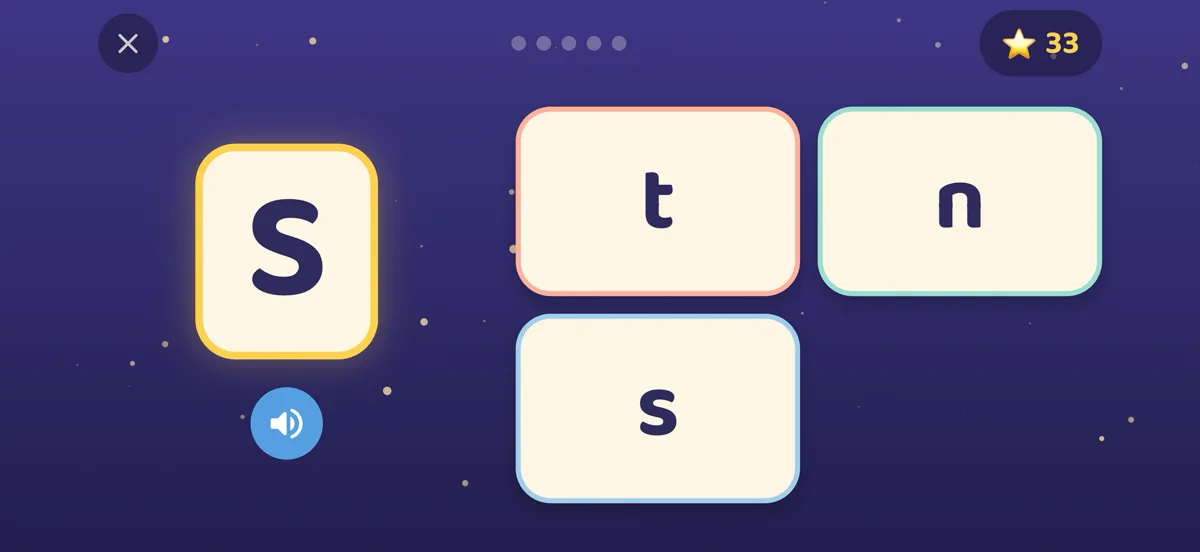
Tähetark letter game: match the big letter S to its lowercase pair.
A

Letters through their sounds

Otto says each letter’s SOUND (not its name) in a clear native voice — Estonian or English, whichever you choose — and your child picks the matching letter. That’s phonics: exactly how the foundation for reading is built. No reading skills needed — everything is spoken aloud.

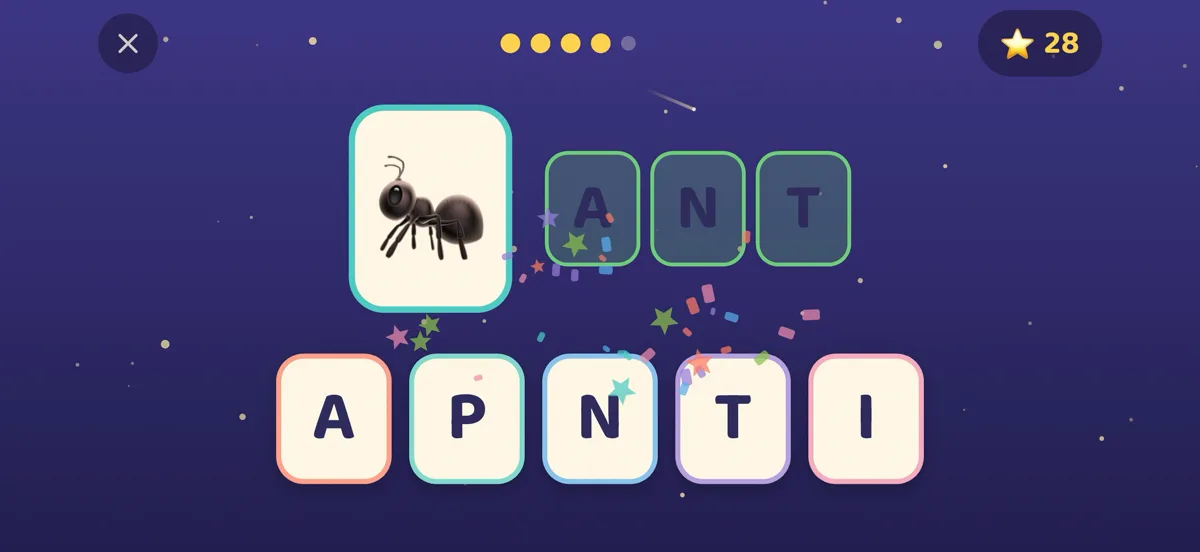
Tähetark word game: the child builds the word ANT letter by letter.
✏️

First words and early reading

Single letters snap together into real words, each with its picture (D + OG = DOG). Your child connects the sound, the letter and the meaning — the first real step towards reading.

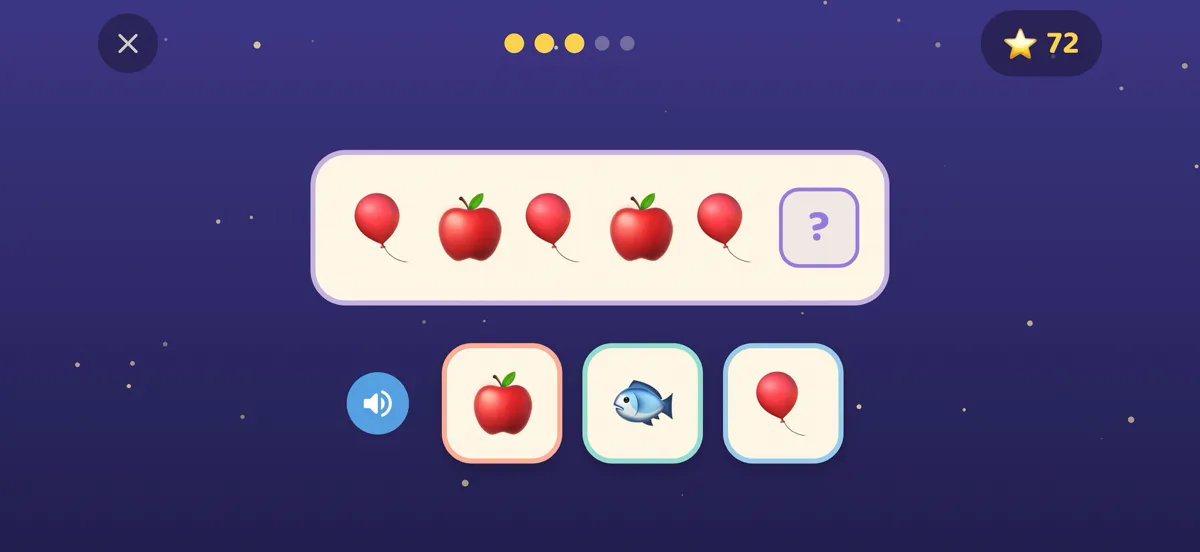
Tähetark counting game for kids: count the apples and pick the right answer.
123

Counting and number sense

Your child counts real things, learns to recognise small quantities at a glance, and builds a confident feel for numbers — the foundation all of maths rests on.

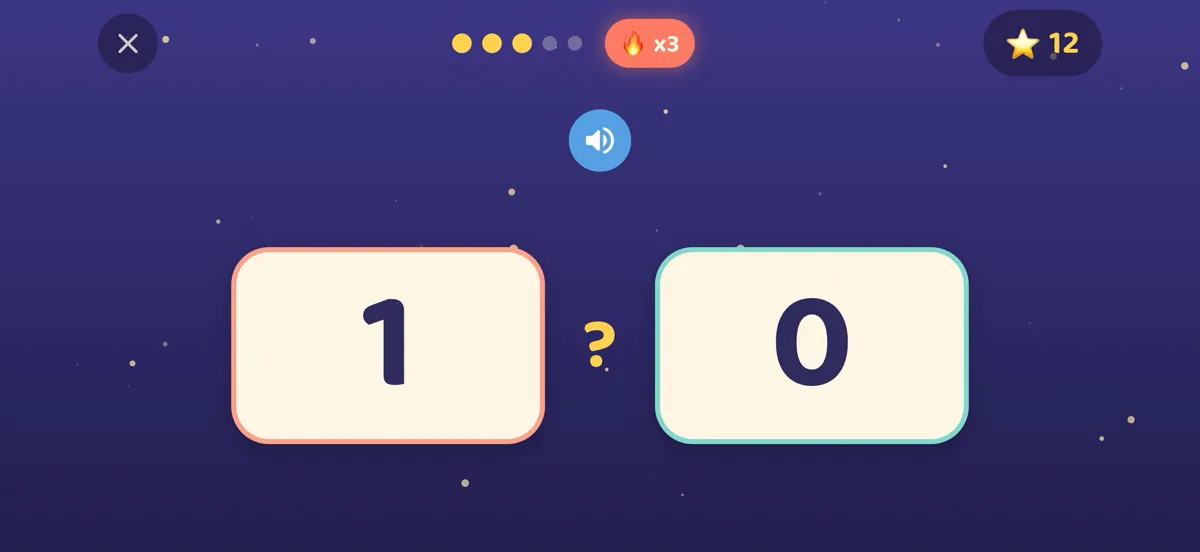
Tähetark number game: which number is bigger?
123

Numbers and first maths

Big, clear numbers: what comes next, which is bigger, first addition and subtraction. Numbers can be traced with a finger, too. All in small steps, with zero pressure.

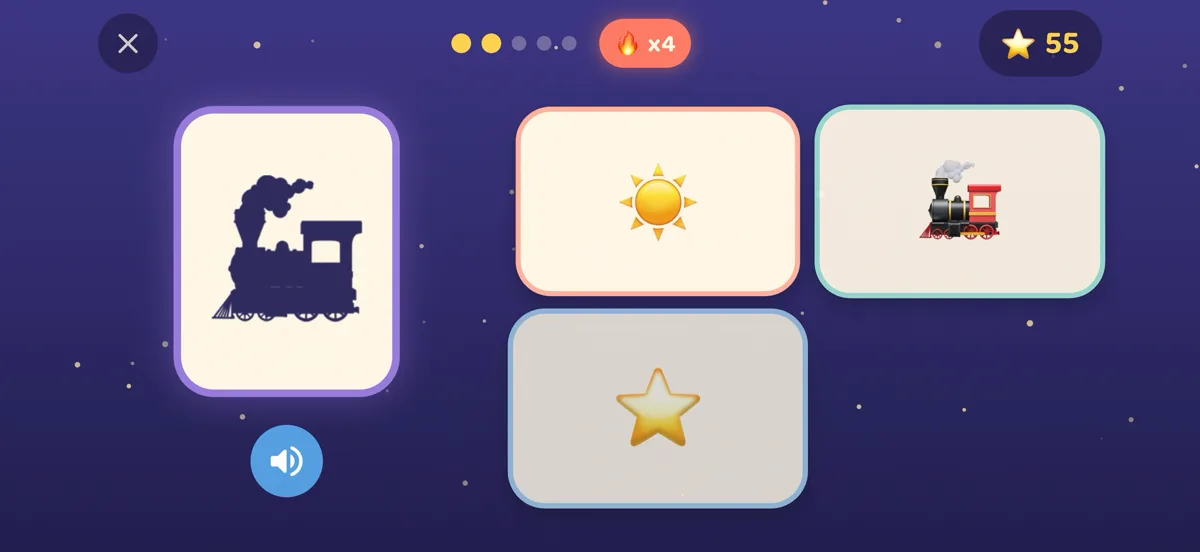
Tähetark matching game: shapes, colours and logic — match the shadow to the right picture.
🎨

Shapes, colours and logic

Shadows, shapes, colours and simple logic: your child learns to notice, compare and solve patterns. Learning feels like a game — because it is one.

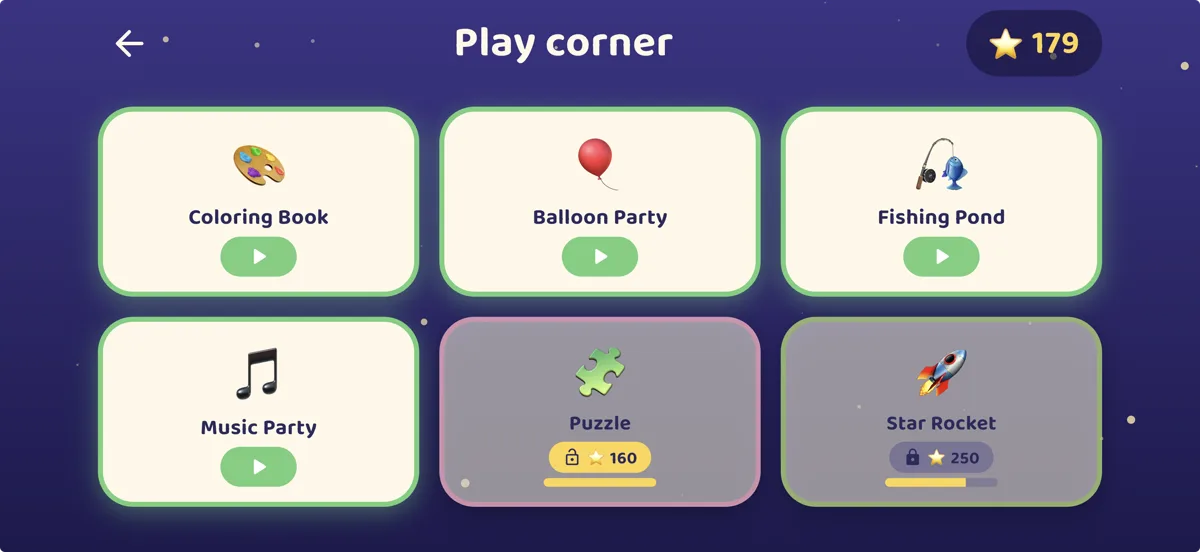
Tähetark game corner: bonus games unlocked with stars earned by learning.

Earn stars, unlock new games

Every skill mastered earns stars. Your child spends them on bonus games: a colouring book, fishing, a rocket ride and more. The stars are earned through real learning.

The science behind it

Not just an educational game

Tähetark tracks your child's progress and adapts to them. Every learning mechanic is built on published developmental and learning research and Estonia's national preschool curriculum.

Adapts to the child, not their age

Every letter, sound and number is tracked on its own. Difficulty rises as your child masters it, and a new group opens only once the last one is solid — keeping them just above what they already know, in the zone of proximal development (e.g. Wilson et al., 2019).

Spaced repetition

What's learned comes back at widening intervals — 10 minutes, a day, three days, a week — and the child recalls the answer themselves. Spaced practice is one of the strongest tools for lasting memory (Vlach & Sandhofer, 2008/2012).

Sounds before letter names

Estonian letters are taught sound-first, the way teachers do — the child hears the sound before the name. English follows a synthetic-phonics order (s, a, t, p, i, n) so simple words can be blended early.

Numbers as part and whole

Numbers are built from blocks and grouped in fives and tens: the child sees that 7 is “5 and 2” and 14 is “a ten and 4”. The linear number line and grouping come from early-maths research (Siegler & Ramani; Starkey & McCandliss).

Variety and the right kind of praise

A session interleaves letters, numbers and shapes, helping the child tell concepts apart (Rohrer). Praise is about effort — “you practised and found it!”, not “you're so smart” (Gunderson & Dweck, 2013).

No tricks

No loot boxes, no random rewards, no countdown timers, no pressure. Each bonus game costs a fixed, visible number of stars, and stars are earned only by learning — so effort is what unlocks the fun.

Research basis

The studies behind Tähetark

Every pedagogical decision in Tähetark — spaced repetition, active retrieval, interleaved practice, phonics before letter names, spatial play and process praise — is grounded in peer-reviewed research. Each claim links to the original publication so you can verify it yourself.

Adaptive difficulty

Tähetark keeps task difficulty where the child answers correctly ~85% of the time — the scientifically optimal learning rate. Anchored in Vygotsky's Zone of Proximal Development and Bjork's "desirable difficulties".

  • The optimal training accuracy is approximately 85%.Wilson, R. C., Shenhav, A., Straccia, M., & Cohen, J. D. (2019). The Eighty Five Percent Rule for optimal learning. Nature Communications, 10, 4646. doi.org/10.1038/s41467-019-12552-4
  • Children learn fastest just beyond their independent ability — the Zone of Proximal Development.Vygotsky, L. S. (1978). Mind in Society. Harvard University Press. archive.org
  • Desirable difficulties slow short-term performance but strengthen long-term memory.Bjork, R. A. (1994). Memory and metamemory considerations in the training of human beings. In Metacognition: Knowing about knowing (pp. 185–205). MIT Press. gwern.net (PDF)

Spaced repetition and active retrieval

Reviews are scheduled at expanding intervals: 10 min → 1 day → 3 days → 7 days → 21 days. Every review asks the child to recall — not watch a replay. The single most evidence-backed technique for durable memory.

  • Meta-analysis of 317 experiments: distributed practice outperforms massed practice in long-term retention.Cepeda, N. J., Pashler, H., Vul, E., Wixted, J. T., & Rohrer, D. (2006). Distributed practice in verbal recall tasks. Psychological Bulletin, 132(3), 354–380. doi.org/10.1037/0033-2909.132.3.354
  • Spacing improves memory, problem-solving and transfer to new situations.Kang, S. H. K. (2016). Spaced repetition promotes efficient and effective learning. Policy Insights from the Behavioral and Brain Sciences, 3(1), 12–19. doi.org/10.1177/2372732215624708
  • Spacing works with 5–7-year-olds: spaced learners generalized concepts significantly better.Vlach, H. A., & Sandhofer, C. M. (2012). Distributing learning over time. Child Development, 83(4), 1137–1144. doi.org/10.1111/j.1467-8624.2012.01781.x
  • Active retrieval doubles long-term retention compared to re-reading.Roediger, H. L., & Karpicke, J. D. (2006). Test-enhanced learning. Psychological Science, 17(3), 249–255. doi.org/10.1111/j.1467-9280.2006.01693.x

Interleaved practice

Rather than grouping all letters, then all numbers, then all shapes, Tähetark mixes types within every session. This forces the child to decide each time what they are seeing — building discrimination and transfer far better than blocked practice.

  • Mixed math problems tripled test scores versus blocked practice, despite lower practice-session performance.Rohrer, D., & Taylor, K. (2007). The shuffling of mathematics practice problems improves learning. Instructional Science, 35(6), 481–498. doi.org/10.1007/s11251-007-9015-8
  • Interleaving helps children distinguish among similar concepts and pick the right strategy.Rohrer, D. (2012). Interleaving helps students distinguish among similar concepts. Educational Psychology Review, 24(3), 355–367. doi.org/10.1007/s10648-012-9201-3

Phonological awareness and synthetic phonics

Tähetark introduces each letter through its sound, not its name. The teaching order is deliberate — frequent sounds before rare ones — following synthetic-phonics principles. The evidence here is unambiguous.

  • Systematic phonics is the most effective method for teaching reading — synthesising over 100,000 studies.National Reading Panel. (2000). Teaching children to read. NICHD. nichd.nih.gov
  • 66 experiments (d = 0.41): systematic phonics improved reading across all ages; the effect is largest before first grade.Ehri, L. C., Nunes, S. R., Stahl, S. A., & Willows, D. M. (2001). Systematic phonics instruction helps students learn to read. Review of Educational Research, 71(3), 393–447. doi.org/10.3102/00346543071003393

Number sense and mathematical foundations

Tähetark builds number sense at three levels: a linear number line (magnitude as position), grouping by fives and tens, and instant recognition of small quantities. Numbers are always introduced concretely before abstractly.

  • Four short number-line game sessions improved preschoolers' number sense; gains held nine weeks later.Siegler, R. S., & Ramani, G. B. (2008). Playing linear numerical board games promotes low-income children's numerical development. Developmental Science, 11(5), 655–661. doi.org/10.1111/j.1467-7687.2008.00714.x
  • Grouping items into fives correlates with arithmetic skill from Grade 1 to 3.Starkey, G. S., & McCandliss, B. D. (2014). The emergence of "groupitizing" in children's numerical cognition. Journal of Experimental Child Psychology, 126, 120–137. doi.org/10.1016/j.jecp.2014.03.006
  • Moving from concrete to abstract improves understanding of mathematical concepts.Fyfe, E. R., McNeil, N. M., Son, J. Y., & Goldstone, R. L. (2014). Concreteness fading in mathematics and science instruction. Educational Psychology Review, 26(1), 9–25. doi.org/10.1007/s10648-014-9249-3
  • Subitizing — knowing at a glance how many — is a key number-sense skill developed through structured play.Clements, D. H., & Sarama, J. (2014). Learning and Teaching Early Math (2nd ed.). Routledge. routledge.com

Process praise, play and spatial skills

Tähetark praises effort, not intelligence. The bonus Tangram game trains spatial skills linked to mathematical growth. All activities are playfully framed — playful learning demonstrably outperforms rote instruction for young children.

  • Praising the person ("you're smart") undermined persistence; praising the process ("you worked hard") kept motivation after failure.Mueller, C. M., & Dweck, C. S. (1998). Praise for intelligence can undermine children's motivation and performance. Journal of Personality and Social Psychology, 75(1), 33–52. pubmed.ncbi.nlm.nih.gov/9686450
  • Process praise in infancy predicts a growth mindset and math confidence five years later.Gunderson, E. A., et al. (2013). Parent praise to 1- to 3-year-olds predicts children's motivational frameworks 5 years later. Child Development, 84(5), 1526–1541. doi.org/10.1111/cdev.12064
  • Randomised study of 17,000 children: training spatial cognition improved mathematics at ages 6–8.Judd, N., & Klingberg, T. (2021). Training spatial cognition enhances mathematical learning in a randomized study of 17,000 children. Nature Human Behaviour, 5, 1548–1554. doi.org/10.1038/s41562-021-01118-4
  • Spatial assembly ability at age 3 predicts early mathematical skills.Verdine, B. N., Golinkoff, R. M., Hirsh-Pasek, K., & Newcombe, N. S. (2014). Deconstructing building blocks. Child Development, 85(3), 1062–1076. doi.org/10.1111/cdev.12165
  • Playful learning supports children's cognitive development. (Evidence review; not a primary study.)Zosh, J. M., et al. (2017). Learning through play: A review of the evidence. LEGO Foundation. learningthroughplay.com (PDF)

Tähetark is aligned with Estonia's National Curriculum for Preschool Child Care Institutions (RT I 2008, 23, 152) across language and speech, mathematics, play and movement.

Trust

Why Tähetark is different

Built the way I’d want my own child to learn.

Backed by learning science

Spaced repetition, with progress at exactly the pace your child is ready for. Every session ends in success — there is no way to lose.

By skill, not by age

Tähetark never asks how old your child is. The difficulty adapts: when something is tricky, Otto stays with it; when it clicks, they move on.

Two languages, one warm voice

Otto speaks clear, accent-free Estonian and friendly English — the whole app works fully in both, switchable anytime in the parents’ corner. Your child hears correct pronunciation and repeats it, just like learning at your side.

No ads, no tracking

Tähetark shows no ads, tracks no one and collects no data about your child. COPPA- and GDPR-safe. Works completely offline, too.

Made for kids

Carries Apple’s “Made for Kids” badge (App Store kids’ category). A safe place where your child can puzzle things out alone — without you having to worry.

One dad, one dream

There is no big company or investor behind Tähetark. One dad is building it for his four-year-old son — and now for your child, too.

Real families

Real kids, real joy

Not child actors — real children discovering letters, numbers and colours in Tähetark.

Discovering letters and numbers
Enjoying the colouring game
Putting together first words

Why I’m doing this

It started with wanting something better for my son.

My son is four. I went looking for an app that would teach him letters and numbers in our own language, without throwing ads at him or trying to keep him glued to the screen. I couldn’t find one. So I started building it myself — in the evenings, after he had fallen asleep.

Tähetark grew bigger than I ever planned. Otto learned to speak — first Estonian, then English too — letters became sounds, then came numbers, games, stars to earn. But I am one person. Every family that downloads Tähetark is living proof that I’m not building this only for my son — that real families truly need it. That is what keeps me going and keeps making Tähetark better.

I can promise you just one thing: I will do my very best to build an app you’re genuinely happy to sit down with your child and use.

Martti

Martti Randma, maker of Tähetark and dad of one little stargazer

Start today

Tähetark is available in both stores. One-time purchase of €9.99 — no ads, no subscriptions.

FAQ

Frequently asked questions

Can I download Tähetark now?

Yes! Tähetark is available on both the App Store (iPhone, iPad) and Google Play (Android). Download it, make the one-time €9.99 purchase and your child can start right away.

How much does Tähetark cost?

Tähetark costs €9.99. It is a one-time purchase — no subscriptions and no in-app purchases.

Where can I download Tähetark?

You can download Tähetark from the App Store (iPhone, iPad) or Google Play (Android). Pick the store that matches your device and download it.

What age is Tähetark for?

It’s best suited to children aged roughly 2–7, so a 4-year-old is right in the sweet spot. Tähetark goes by skill, not age: the difficulty adapts to your child and grows with them.

What languages does Tähetark support?

Estonian and English — the whole app works fully in both, and you can switch languages anytime in the parents’ corner. Otto teaches Estonian letters through their sounds and English letters through phonics.

Does Tähetark work offline?

Yes, completely. Once downloaded, Tähetark needs no internet connection — and no ads will ever interrupt your child.

Is Tähetark free of ads and tracking?

Yes. No ads, no tracking, no data collected about your child. Tähetark is COPPA- and GDPR-safe and meets Apple’s “Made for Kids” requirements.

Is it really made by one dad?

Yes. There is no company or investor behind Tähetark — it is built by Martti Randma, one dad, for his little son.